Science · preliminary
Five people on two coastlines
We sat people in front of the sea, recorded their brain, heart and breathing alongside the sound of the water, and asked whether the body falls into step with it.
This is a pilot. Five subjects, one session each, blocks of a few minutes. It was run to find out whether the recording and the analysis work at all before committing to the full study, and that is the weight the results on this page can carry. Everything below is drawn from the analysis output, and every figure names the file it came from.
Part one
The recording
What was measured, where, and the one thing that has to be true before any of the rest is worth asking.
The field
A microphone, a body, and the sea
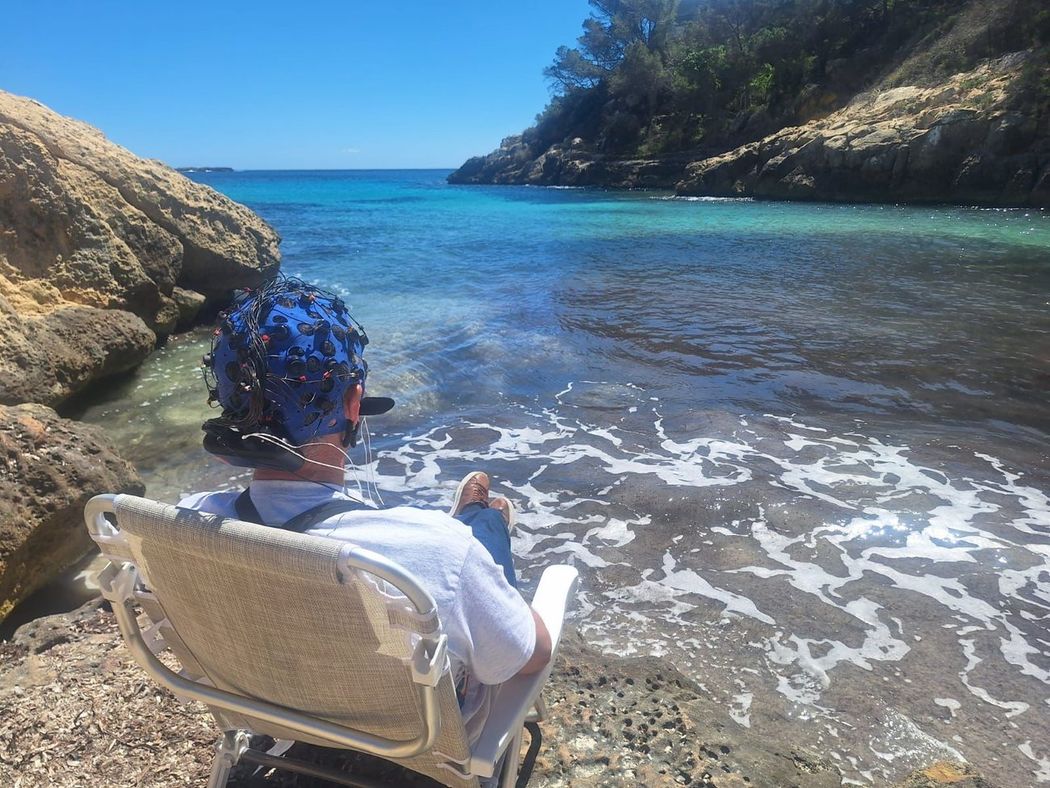
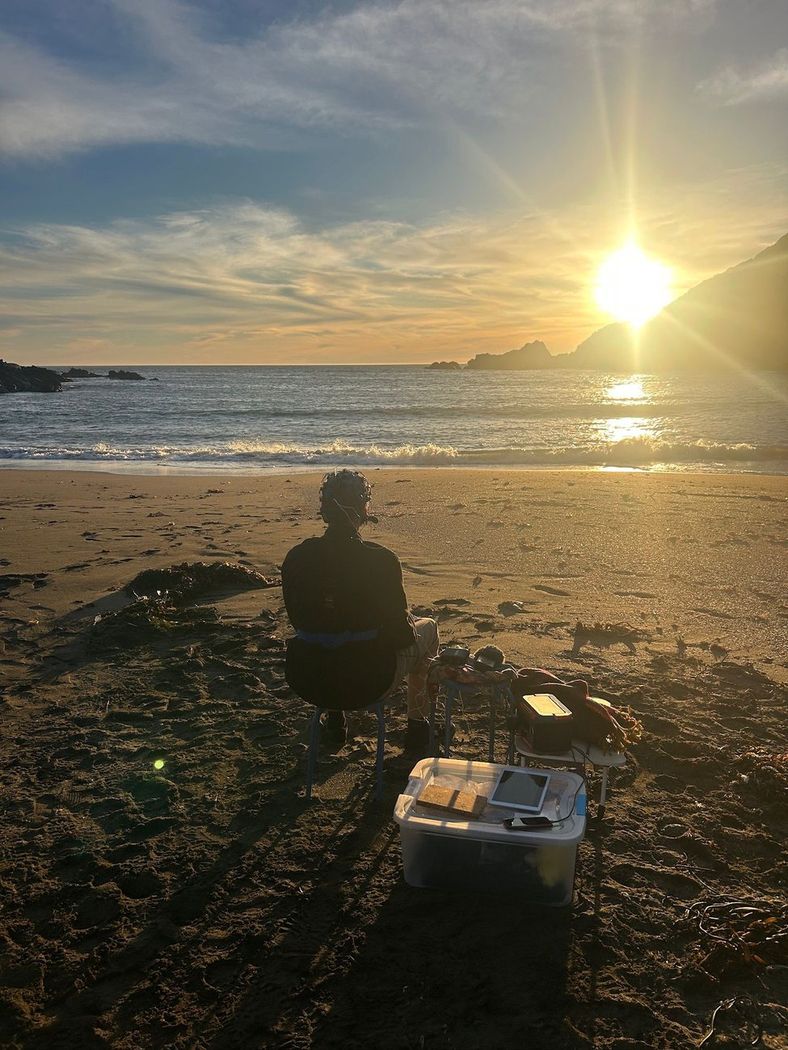
Five adults took part in outdoor sessions facing the water, on the Chilean coast and on Mallorca. Each wore 32-channel EEG, a single-lead ECG and a respiration belt, while a binaural microphone beside them recorded the same sea they were sitting in front of. All the streams share a clock.
Each person met the sea three ways, in blocks of three to six minutes: watching it with their hearing blocked, listening to it with their eyes covered, and both at once. Two silent rests bracketed the session, one before and one after, and those are what the nature blocks get compared against.
The premise
Is there anything in the sound a body could track?
The question it asks
Do the sea and the breath even operate at the same speeds?
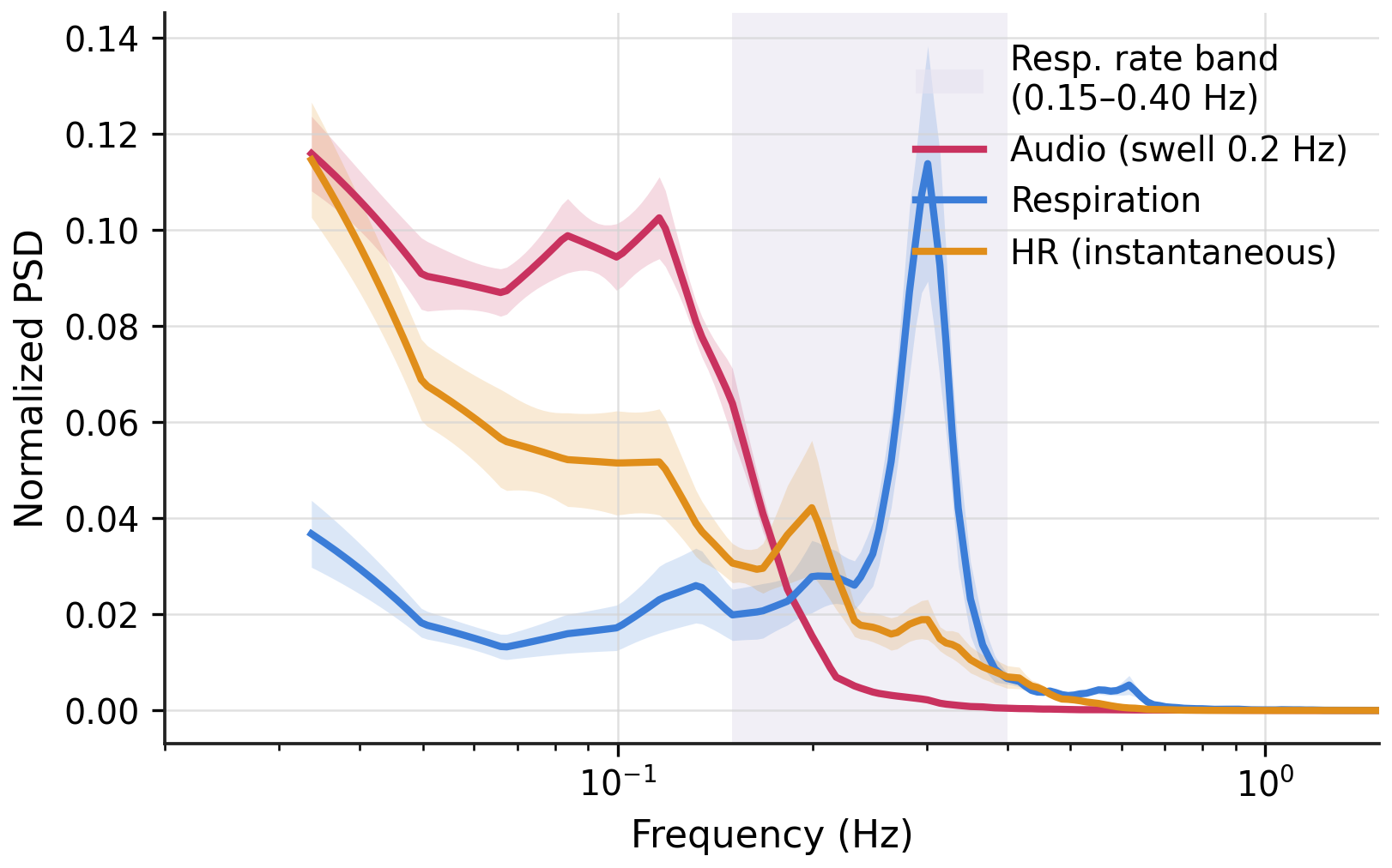
Before asking whether the body follows the water, the water has to carry energy at a rate the body could plausibly follow. It does. The slow swell of the audio sits mostly below 0.1 Hz, and breathing sits around 0.25 Hz, inside the band it always occupies. They overlap enough for the question to be worth asking.
Audio, breathing and heart rate, group mean
In one sentence
The sea moves slowly enough, and breathing is slow enough, that the two could in principle keep time with each other.
Part two
What came out
Three results the pilot supports, each a comparison rather than an absolute claim, and each shown with all five subjects visible.
Nature against rest
Breathing couples more with the sea than with silence
Pooling the three nature blocks against the two rests gives one comparison per subject. The phase measures, which ask whether two rhythms hold a steady timing relationship, go up during nature. Phase-locking value gives p = 0.027 and the weighted phase-lag index p = 0.0067, both from a model fitted on roughly 440 windowed values.
Those two are the breathing rows below. The same contrast was run against two derivations of the heartbeat as well, and those are shown beside them.
Nature versus rest, on the two phase measures
nature_vs_rest_stats.csv.Blind to · multiplicity. Twelve comparisons were run and none of these p-values are corrected for that. At this size the honest reading is a direction worth following, not a result to bank.
Which sense
Listening does it; looking does not
The question it asks
Does it matter which sense the sea arrives through?
Among the three conditions, listening with eyes covered produces the strongest respiratory coupling, around twice what watching or watching-and-listening give. Adding vision does not add to it. It takes it away.
Two measures are shown because they fail differently. The weighted phase-lag index throws away the zero-lag part of the relationship, which is the part a shared artefact would produce, so when it agrees with the plain phase-locking value the result is harder to explain away. Here they agree.
Five subjects, three ways of meeting the sea
coupling_summary_all.csv.In one sentence
Listening to the sea couples breathing to it about twice as strongly as looking at it does, and adding sight to sound does not help.
The pilot also ran coherence, cross-correlation and mutual information, which answer differently. The four families of coupling measure, and what each is blind to, are worked through properly in Learn: Attunement.
Timing
And they do it at the same point in the breath
This is the cleanest thing five subjects can show. For each person we take the breathing phase at which their coupling to the swell was strongest, and ask whether those phases agree across people. Under listening they largely do, with four of five subjects internally consistent and the group resultant at R = 0.73, which the report gives as p = 0.060, a trend. Add vision and the agreement collapses to R = 0.22.
Does everyone breathe at the same point in the wave?
R runs from 0, arrows pointing everywhere, to 1, all pointing the same way. The p is quoted from the report rather than recomputed here.
phase_per_subject.csv.In one sentence
Something about watching the sea moves each person’s timing in a different direction, while listening to it moves them all to the same place.